Don Bosco TVET Centres discuss Integration of the “Greening” concept into Training Programs
-
by
pdo
Kigali, Rwanda – December 11, 2025 – Don Bosco Technical and Vocational Training (TVET) Centres concluded a crucial three-day Training of Trainers (ToT) session in Kigali this week, focused on embedding a new “green module” across their programs.
The training, held from Monday, December 8th to Wednesday, 10th, 2025, is a core component of the “Gender Matters for Green TVET Project”, implemented in Don Bosco TVET Centres in Uganda and Rwanda. The Austrian Development Cooperation and Jugend Eine Welt fund the Project. The Salesian Planning and Development Office implement it.
Father Servilien UFITAMAHORO, the director of the planning and development office, thanked participants and highlighted the project’s goal, stating that it is intended to “help our centers grow not only in one sector but now we are actually touching all the sectors”.
Greening: Protecting the Environment and People
Participants confirmed that the training redefined their understanding of sustainability. One of the trainer, who works with the Salesians of Don Bosco in Palabek, Uganda—where they serve around 95,000 refugees and host communities—explained her broadened perspective:
“Greening at first I was looking at the green environment… But it gave me a broadly thinking or ideas of greening”.
She now understands that greening is about more than aesthetics; it means having “environment in mind with a future means that if you are In greening, you have to protect your environment. You have to keep your environment safe. You have to keep the people around you safe”.
This concept is especially important for regions like the Palabek settlement, which experiences poor waste management, prompting her to advocate for proper practices like recycling, reusing, and replacing bottles and plastics.
Empowering Girls for the Job Market

Gender equality is central to the project’s mission for Don Bosco schools. Ms. Bianca from St Joseph VTC in Uganda noted that the project is encouraging both boys and girls because “a girl child is empowered to have the same right as a boy child”.
Training students in greening is expected to give them a significant competitive advantage in employment. She explained that when graduates enter the job market, they will be able to “set an example” for other companies or factories that have not yet adapted greening practices.
Future Requests: Uniform Certification and Exchange
Program Manager Mutala Innocent addressed participant feedback regarding the next steps for the project. Key requests focused on deepening knowledge and standardizing assessment:
- Professional Development: Trainers requested more specialized instruction, asking that the organization “advocate for some experts that can be taking us for short courses also as trainers”.
- Interaction and Exchange: Participants requested the possibility of “exchange visits if it’s possible that maybe the teachers can interact from the different centers”.
- Certification: Innocent confirmed that discussions are underway to address a request for formal recognition: “they were requesting that these students be given an additional certificate having them green in addition to what we received nationally”. The plan is to “set a uniform assessment which can be done across the five centers” to qualify students for the extra certification.
Father Servilian concluded the session by praising the participants, many of whom came from far away, assuring them that the effort was “not a waste of time” as they gained “new people, new experience and then new knowledge” in Kigali.
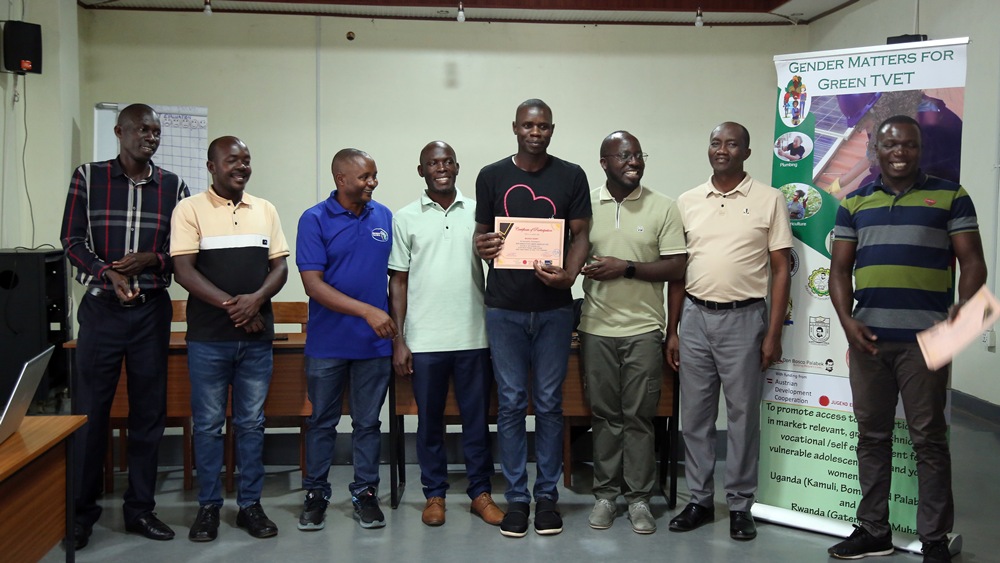
The Training concluded with the award of Certificates of Participation.

SUBSCRIBE TO OUR NEWSLETTER